Thailand is one of those countries people describe as a year-round destination, and technically that is true.
But that does not mean every month feels the same.
A trip to Bangkok in January feels very different from Bangkok in April. Phuket in February is a very different experience from Phuket in September. And one of the biggest mistakes first-time travelers make is assuming the weather works the same across all of Thailand, when in reality the Andaman coast and the Gulf islands often have different sweet spots.
So when is the best time to visit Thailand in 2026?
For most travelers, the best overall time is November to February, when much of the country is drier, cooler, and easier to explore. But that is not always the best time for every budget, every destination, or every travel style. Thailand’s hot season, rainy season, and regional weather differences can all change what “best” really means for your trip.
In this guide, I’ll break down the best time to visit Thailand month by month, including weather, crowds, prices, beach timing, and when different parts of the country make the most sense.
If you are still planning the route itself, read our Thailand itinerary for 7, 10 or 14 days first. And if cost matters most, check how much does a trip to Thailand cost in 2026 before booking.
Quick answer: when is the best time to visit Thailand?
For most travelers, the best overall time to visit Thailand is November to February.
This is the cooler, drier part of the year across much of the country. Temperatures are usually more comfortable, humidity is lower, and sightseeing is easier than during the hottest months. This is also why December and January are among the most popular months to visit.
Here is the simple version:
| Period | What to expect | Best for |
|---|---|---|
| November to February | Cooler, drier, busiest season | First-time trips, sightseeing, classic Thailand routes |
| March to May | Very hot, mixed value | Beach-focused trips, lower crowds before monsoon peaks |
| June to October | Wetter in much of the country, greener, cheaper | Budget travel, fewer crowds, flexible itineraries |
| January to September | Stronger window for many Gulf islands | Koh Samui, Koh Tao, Koh Phangan timing |
| November to April | Stronger window for Andaman coast | Phuket, Krabi, Phi Phi, island hopping |
The key point is that the best time for Thailand overall is not always the best time for every beach area. The Andaman coast usually shines from November to April, while the Gulf coast often performs better during parts of the year when the west coast is wetter.
Thailand weather seasons explained
Thailand’s climate is shaped by monsoon patterns. Official tourism guidance describes a broad pattern of a wet season, a cooler dry period, and a hot season.
In practical travel terms, Thailand usually breaks down like this:
Cool and dry season: November to February
This is the most comfortable time to travel around much of Thailand.
Bangkok is more manageable, northern Thailand is pleasant for temples and outdoor activities, and many of the Andaman beach destinations are in prime condition. This is why these months are widely seen as the safest all-around window for first-time visitors.
Hot season: March to May
Thailand starts heating up fast in March, and April is especially intense in places like Bangkok and central Thailand.
This does not make Thailand a bad destination in spring, but it does change the trip. Cities can feel draining in the middle of the day, while beach destinations often make more sense. Northern Thailand can also become less appealing in late dry season conditions.
Rainy season: roughly June to October in much of the country
Rainy season sounds worse than it often is.
In many parts of Thailand, rain comes in short, heavy bursts rather than nonstop all-day rain. That means you can still travel well during this period, especially if your expectations are realistic. You usually get lower prices, fewer tourists, greener landscapes, and a less hectic overall experience. But some island routes, ferries, and sea conditions become less reliable, especially on the Andaman side in the wetter months.
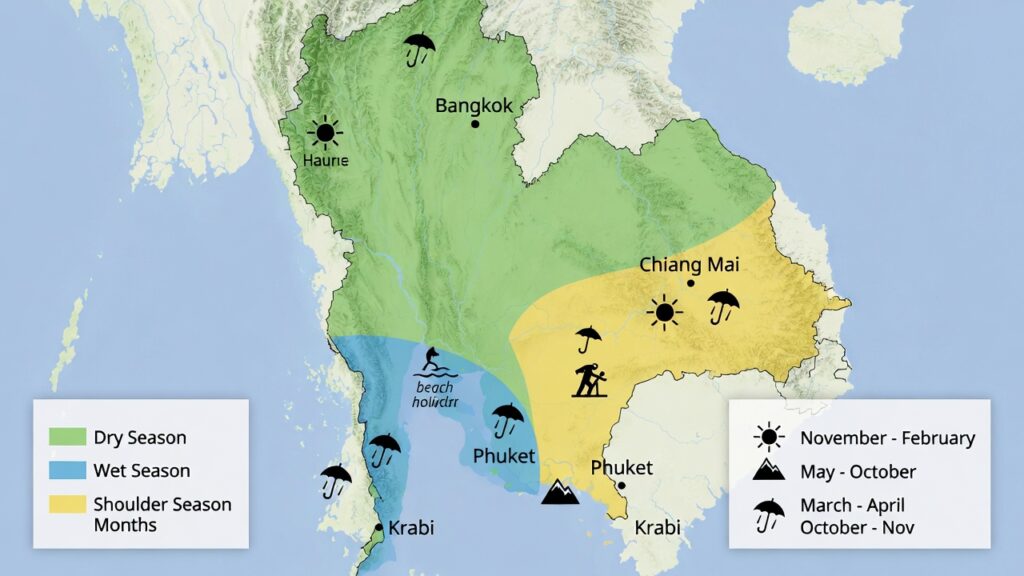
Best time to visit Thailand month by month
January
January is one of the best months to visit Thailand.
Weather is generally dry and comfortable across much of the country, which makes it excellent for Bangkok, Chiang Mai, Phuket, Krabi, and classic first-time routes. The downside is obvious: this is high season, so prices and crowd levels are usually elevated.
Best for: first-time visitors, sightseeing, beaches, mixed itineraries
Watch out for: higher hotel prices and busier attractions
February
February is still one of the strongest months.
You get many of the same advantages as January, often with slightly less holiday pressure than late December and early January. For many travelers, February is one of the best all-around compromises between weather and crowd intensity.
Best for: balanced trips, beach plus city combinations
Watch out for: still-strong peak-season pricing in popular areas
March
March starts to feel hotter, especially inland and in the cities.
It can still be a good month for Thailand, particularly for beach-oriented trips and travelers who do not mind heat. But if your plan is heavy sightseeing in Bangkok or temple-hopping in the middle of the day, comfort starts to drop compared with January or February.
Best for: beach trips, shoulder-season planning
Watch out for: rising heat, especially in central and northern Thailand
April
April is one of the hottest months in Thailand.
For some travelers, that is a deal-breaker. For others, it is still worth it because this is when Songkran takes place, one of the country’s biggest and most memorable festivals. The trade-off is that it can be exhausting for classic sightseeing, especially in Bangkok.
Best for: festival energy, beach time, travelers who can handle heat
Watch out for: extreme temperatures and busy holiday periods
May
May sits in an awkward but sometimes useful position.
It is still hot, and weather patterns begin shifting toward the wetter part of the year in many regions. But this is also when you can start finding better value than peak season, especially if you are flexible and not expecting perfect beach weather every day.
Best for: value-seekers, flexible travelers
Watch out for: heat plus increasing rain risk
June
June is a good month for travelers who care more about value than picture-perfect weather.
Rain risk is higher than in peak season, but this is often where Thailand starts feeling cheaper and less crowded. If you are happy with some afternoon showers and do not need the Andaman coast at its absolute best, June can be a smart trade-off month.
Best for: budget-conscious trips, greener scenery
Watch out for: more unpredictable weather
July
July is part of the wet-season value window for much of Thailand.
This can still be a good time to visit if you want lower hotel prices, fewer tourists, and a more relaxed pace. It also starts becoming more interesting for parts of the Gulf coast, which often perform better than the Andaman side in this broader period.
Best for: lower crowds, better value, Gulf coast planning
Watch out for: mixed weather and rougher conditions on some west-coast routes
August
August is not the best month for a classic all-regions Thailand trip, but it is not a write-off either.
Mainland Thailand can be wet, and the Andaman coast is not in its best form. But some Gulf destinations can still work relatively well, which is why month-by-month planning matters so much here.
Best for: travelers willing to build the trip around the right region
Watch out for: rough seas and wet conditions on the Andaman side
September
September is usually one of the riskier months for the Andaman coast.
This is often one of the wettest and least reliable periods for places like Phuket and Krabi, especially if your trip depends on boat days and island hopping. But if your priority is lower prices and you are willing to avoid the wrong coast, Thailand can still be workable.
Best for: budget travelers with flexible plans
Watch out for: poor Andaman conditions and disrupted sea activities
October
October is a transition month.
Some areas begin improving, but it can still be wet in others. The important thing is that the Gulf islands often have heavier rain later in the year, so October is not a universal reset button for all Thailand beach destinations.
Best for: shoulder-season deals, flexible routing
Watch out for: regional weather differences becoming more important
November
November is when Thailand starts becoming a very strong all-around choice again.
Much of the country improves, temperatures ease, and this is one of the best months for travelers who want good conditions without always paying peak Christmas-season prices. It is also a popular month for cultural events like Loy Krathong.
Best for: first-time visitors, mixed itineraries, classic Thailand travel
Watch out for: rising prices as high season returns
December
December is one of the best but busiest months to visit Thailand.
Weather is attractive across much of the country, especially for standard first-time routes and Andaman coast beach trips. The trade-off is higher prices, heavier crowds, and holiday-season demand.
Best for: classic Thailand holidays, beaches, winter escape trips
Watch out for: peak-season accommodation prices and crowding
Best time to visit Bangkok and northern Thailand
For Bangkok and much of northern Thailand, the most comfortable period is usually November to February.
That is when temperatures and humidity are easier to handle than in the hotter months. For Chiang Mai and the north, this is also the most comfortable general sightseeing period. But not every month in the north works equally well: many travel guides warn that March and April can be rough for Chiang Mai, which is why those months are often treated less favorably for that region.
If your Thailand trip is mostly about city breaks, temples, food, and northern scenery, aim for late November through February if possible.
Best time to visit Phuket, Krabi and the Andaman coast
For Phuket, Krabi, Phi Phi, and much of the Andaman side, the strongest window is usually November to April, with December to March often seen as the sweet spot for the most reliable beach weather and calmer seas.
This matters because the Andaman side is where a lot of first-time Thailand beach trips happen.
If you are also deciding which Andaman base makes more sense, read Phuket vs Krabi for first-time visitors.
If your dream trip is island hopping, longtail boats, calm water, and postcard beach conditions, this is the side of Thailand where timing matters most. Once you move deeper into the wetter season, sea conditions become less reliable and some water-based plans become harder to count on.

Best time to visit Koh Samui, Koh Tao and the Gulf islands
The Gulf side is different.
Official and travel-planning sources consistently note that Koh Samui, Koh Phangan, and Koh Tao follow a different rainfall pattern from the Andaman coast. In practical terms, these islands often work best from roughly January to September, while October to December tends to be a wetter period there.
That is one of the most useful planning edges you can give readers. When Phuket or Krabi are having a rougher stretch, parts of the Gulf can still make more sense.
Cheapest time to visit Thailand
The cheapest time to visit Thailand is usually during the rainier, lower-demand part of the year, often somewhere between June and October, depending on the exact destination.
This is when you are more likely to find lower hotel rates, fewer tourists, and better travel deals. Several travel-planning sources highlight July to September or the broader green season as the best-value period, especially for travelers who care more about price than perfect daily weather.
That said, cheap does not always mean best.
If you want a smooth first trip with minimal weather friction, it is often worth paying more for a stronger season. But if your budget is tight and you are flexible, rainy-season Thailand can still be very rewarding.
Best time to visit Thailand for beaches, island hopping and diving
If beaches are your top priority, the answer depends on which coast you are targeting.
| Region | Best general timing |
|---|---|
| Phuket / Krabi / Phi Phi / Andaman coast | November to April |
| Koh Samui / Koh Tao / Koh Phangan / Gulf coast | January to September |
This is one of the biggest reasons generic Thailand weather advice fails people. A traveler who only hears “avoid rainy season” may miss the fact that one coast can still work much better than the other.

Best time to visit Thailand for fewer crowds
If you hate crowds, avoid the obvious peak windows:
- late December and early January
- major holiday spikes
- and often Songkran in mid-April, depending on the kind of trip you want.
The best compromise months are often:
- late February
- March if you can tolerate heat
- June
- or selective shoulder-season windows where value improves but conditions are still workable.
So when is the best time to go to Thailand?
For most travelers, the best answer is still November to February.
That is the safest all-around period for combining Bangkok, northern Thailand, and one beach destination. Weather is generally more comfortable, the country is easier to move around, and it is the best window for a classic first-time trip.
But that does not mean every other month is bad.
If you want cheaper hotels and fewer crowds, the wetter months can be worth it. If you are focused on the Gulf islands, your ideal timing may be different from someone heading to Phuket or Krabi. And if your trip is mostly about beaches, it is smarter to choose the right coast than to rely on a generic Thailand-wide rule.
Final verdict
The best time to visit Thailand in 2026 depends on what kind of trip you want.
If you want the easiest answer, go between November and February.
If you want lower prices and fewer tourists, look at the green season and build the route around the right regions.
If you care most about beaches, remember that Phuket and Krabi do not follow the same ideal timing as Koh Samui and Koh Tao.
That is the real trick with Thailand: the best month is not just about weather. It is about matching the right month to the right part of the country.
If you are still deciding whether Thailand suits your travel style at all, read is Thailand worth visiting.