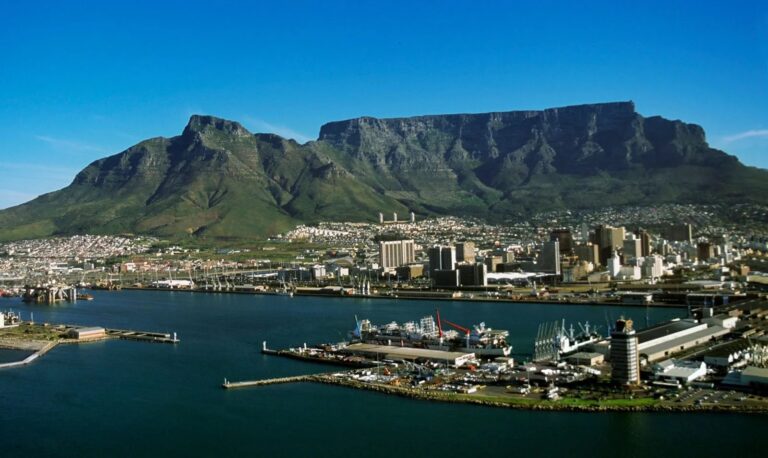
Yes, South Africa is still a realistic destination for tourists, but it is not a low-risk destination. Most visitors who stay in established tourist areas, plan their transport carefully, and follow strict precautions complete their trips without serious problems, but the country belongs in a different risk category from Portugal, Greece, or Albania.
If I were visiting South Africa today, I would still go. I would book secure accommodation, arrange airport transport, avoid walking after dark, keep valuables hidden, and plan every city transfer instead of improvising it.
South Africa’s crime problem is real. Armed robbery, carjacking, violent mugging, kidnapping, and smash-and-grab theft are not just theoretical warnings. The correct approach is not panic, but disciplined planning.
For the wider itinerary, costs, and booking order, read How to plan a trip to South Africa.
What the official travel advisories actually say
The U.S. State Department currently rates South Africa Level 2: Exercise Increased Caution because of crime, terrorism, unrest, and kidnapping.
Its advisory specifically names:
- armed robbery
- rape
- carjacking
- mugging
- smash-and-grab attacks on vehicles
- kidnapping for money
- protests that can become violent
The UK travel advice for South Africa independently warns about violent muggings, carjacking, house robbery, sexual assault, murder, and a higher threat after dark.
Canada advises travelers to exercise a high degree of caution because of the significant level of serious crime. Australia uses similar language and says crime and violence are serious issues throughout the country.
That matters because this is not one government being unusually cautious. Several countries are describing the same risk pattern independently.
South Africa is a different risk category, but still very doable
South Africa is not dangerous in the sense that every tourist is constantly under threat. It is dangerous in the sense that a mistake that would merely be inconvenient in Lisbon or Athens can expose you to a much more serious risk there.
Examples:
- walking twenty minutes back to your hotel after dinner
- stopping at a deserted traffic light with your phone visible
- following a GPS shortcut through an unfamiliar neighborhood
- driving a rural road after dark
- accepting transport from an unofficial driver
- visiting a township without a reputable guide
None of those decisions guarantees trouble. They are simply unnecessary risks in a country where violent crime is genuinely more common.
Cape Town vs Johannesburg: the safety difference
Cape Town and Johannesburg should not be treated as the same travel experience.
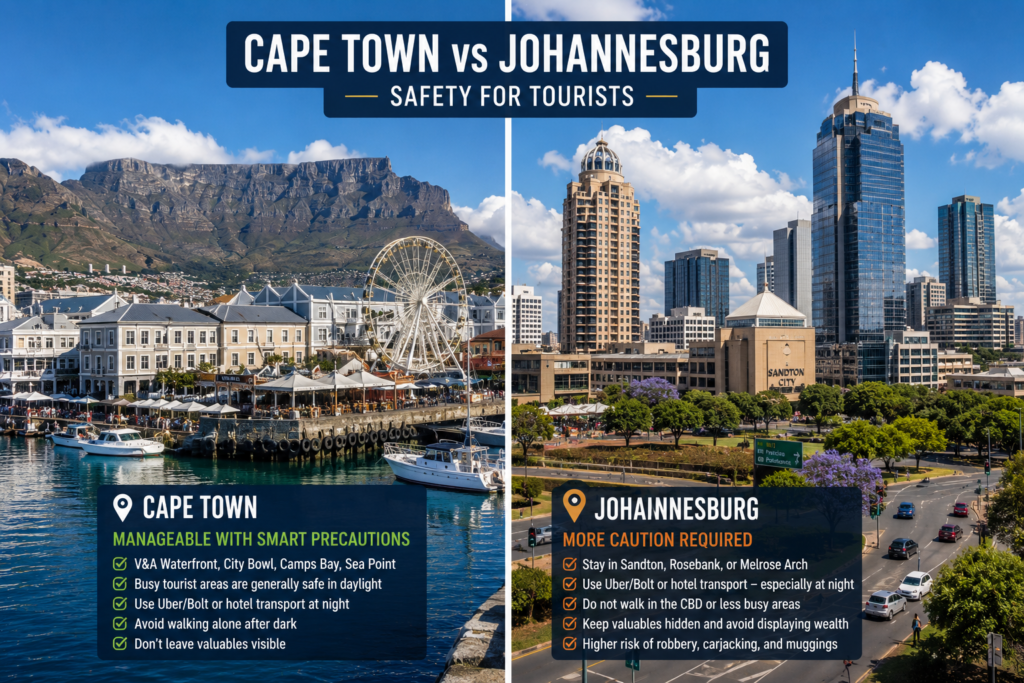
Cape Town has a large, established tourist circuit where visitors can move relatively comfortably with sensible precautions. Johannesburg is more spread out, less naturally walkable, and requires stricter transport planning.
Is Cape Town safe for tourists?
Yes, Cape Town is manageable for tourists, especially if you stay within well-established visitor areas and avoid unnecessary walking after dark.
The easiest areas for a first-time visitor are:
- V&A Waterfront
- City Bowl
- Sea Point
- Camps Bay
- central parts of Green Point
These are not crime-free zones. They are simply easier because they have hotels, restaurants, visible security, regular visitors, and established transport options.
V&A Waterfront
The V&A Waterfront is one of the easiest places in Cape Town for a nervous first-time visitor. It is busy, heavily visited, and has visible private security.
I would feel comfortable walking within the Waterfront complex during normal operating hours. I would still use a ride rather than wandering from the Waterfront into quiet surrounding streets late at night.
City Bowl
The central City Bowl is practical for restaurants, hotels, and sightseeing during the day. Busy central streets can feel normal and active, but the atmosphere changes quickly once businesses close and foot traffic disappears.
Walk in populated areas during daylight. At night, use a trusted ride app even when the distance looks short.
Camps Bay and Sea Point
Camps Bay and Sea Point are popular, scenic, and generally easier for tourists than many other parts of the city.
The main mistake is assuming an attractive beachfront area is automatically safe late at night. Avoid deserted beach sections, dark side streets, and long solo walks after restaurants close.
If you are planning accommodation there, read Is Cape Town expensive for tourists?
Table Mountain and hiking safety
Do not hike Table Mountain alone.
Use marked routes, travel with other people, carry a charged phone, and start early enough to finish well before dark. Robbery has occurred on hiking routes, and rapidly changing weather creates a separate safety risk.
The official Cape Town Tourism safety page recommends hiking in groups, staying on marked paths, carrying a charged phone, and returning before dark.
Cape Town airport transfer safety
Arrange a hotel transfer or use a trusted ride-hailing app from Cape Town International Airport.
Do not allow GPS to send you onto random secondary roads. Current Canadian travel guidance specifically advises using the main N2 and Airport Approach Road and avoiding unsafe detours through areas around Nyanga or Borcherds Quarry Road.
This is one of the strongest examples of why route planning matters in South Africa.
Is Johannesburg safe for tourists?
Johannesburg is visitable, but I would treat it more seriously than Cape Town.
For a first trip, I would stay in:
- Rosebank
- Sandton
- Melrose Arch
- the established northern suburbs
These areas have major hotels, shopping centers, restaurants, business traffic, private security, and better transport connections.
Rosebank
Rosebank is one of the most practical tourist bases because it has hotels, restaurants, malls, galleries, and a Gautrain station.
You can walk between busy venues during the day, but I would still use a ride after dark rather than assuming the entire surrounding area is pedestrian-friendly.
Sandton
Sandton is another straightforward base, especially for business-style hotels, shopping, and connections to OR Tambo Airport through the Gautrain.
It feels more controlled than central Johannesburg, but it is not a place to display phones, watches, jewelry, or cash carelessly.
Johannesburg CBD and inner-city areas
I would not use Johannesburg CBD as a first-time visitor base simply to save money.
Parts of the inner city contain important cultural attractions, but the security situation changes block by block. Visit with a clear destination, current local advice, and planned drop-off and pickup rather than wandering without a route.
Do not walk through central Johannesburg after dark.
Soweto and townships
Soweto has major historical sites and is absolutely worth understanding, but visit through a reputable guided tour.
Do not enter informal settlements or townships independently because someone online described them as authentic or misunderstood. Even U.S. government staff face travel restrictions in many informal settlements around Cape Town.
Driving safety in South Africa
Driving gives you access to the Garden Route, wine country, safari areas, and remote scenery, but it also introduces one of the country’s biggest safety risks.
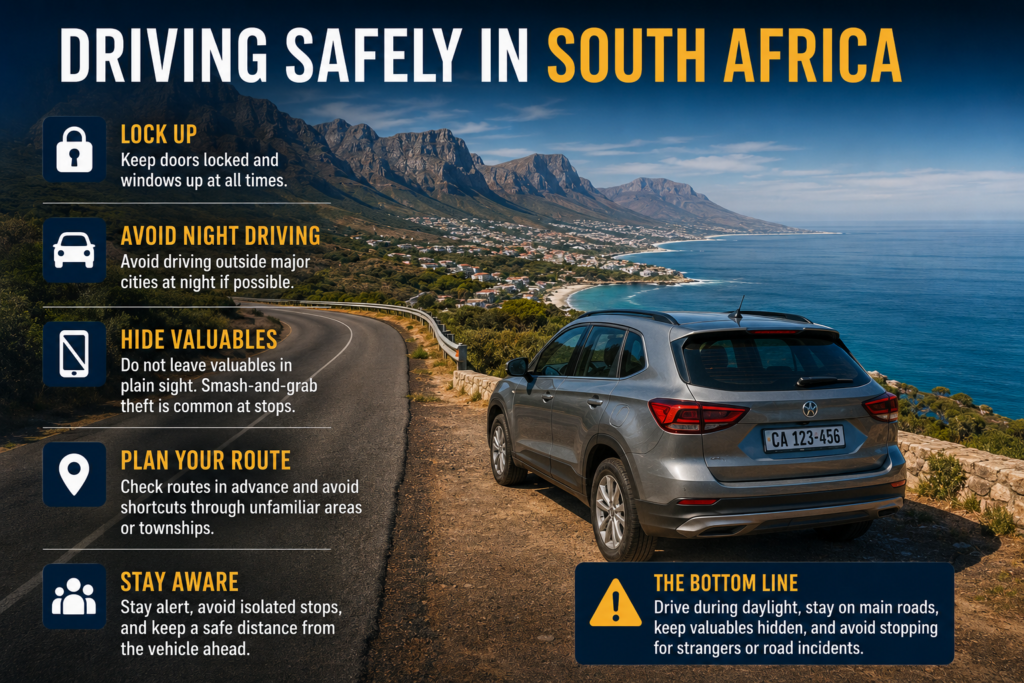
Keep doors locked and windows closed
Keep your doors locked and windows up while driving, including in daylight.
At traffic lights, stop signs, off-ramps, and slow intersections:
- keep phones and bags out of sight
- do not leave valuables on passenger seats
- leave enough space to move around the vehicle ahead
- stay aware of people approaching the car
Smash-and-grab attacks frequently happen when vehicles are stationary.
Avoid driving after dark
Avoid driving outside major metropolitan areas at night whenever possible.
The reasons are broader than crime:
- carjacking risk
- unlit roads
- pedestrians and animals
- broken-down vehicles
- potholes
- impaired or aggressive drivers
- limited assistance if something goes wrong
Plan road-trip days so you reach your accommodation before sunset.
Do not stop in isolated areas
Do not stop for strangers, apparent accidents, stones thrown at the vehicle, or people offering roadside help in an isolated area.
If you have a tire problem, continue to a busy petrol station or secure public place when it is safe to do so.
Do not trust every GPS route
Navigation apps optimize for distance and time, not personal safety.
Ask your hotel, rental company, or local host to confirm routes, particularly:
- airport transfers
- drives near townships
- approaches to national parks
- rural shortcuts
- routes affected by protests or roadblocks
Public transport, Uber, Bolt, and taxis
For most visitors, the cleanest city transport options are:
- Uber or Bolt
- hotel-arranged transfers
- established private shuttle companies
- Gautrain between OR Tambo, Sandton, Rosebank, and Pretoria
- MyCiTi buses on established Cape Town tourist routes
Ride-hailing apps
Uber and Bolt are preferable to accepting random street transport, but use them properly:
- verify the number plate
- verify the driver’s name and photo
- share the trip with someone
- sit in the back
- keep doors locked and windows closed
- avoid pickups directly beside hostile taxi ranks
- never get into a car because the driver says the app is not working
Minibus taxis
Do not use public minibus taxis as a first-time foreign visitor.
They are cheap and widely used locally, but official travel guidance warns about assaults, robberies, poor driving, route confusion, and conflict between transport operators.
Trains
The Gautrain is the main rail service I would confidently recommend for a normal tourist route.
Do not assume all commuter rail systems are equally safe or reliable. General metropolitan commuter trains and some stations carry higher risks of robbery, poor maintenance, and assault.
What to avoid entirely
For a first-time visit, avoid:
- walking alone after dark
- entering townships without a reputable guide
- using informal minibus taxis
- displaying expensive jewelry or watches
- holding your phone visibly while walking
- leaving bags on restaurant chairs
- driving rural roads at night
- following unverified GPS shortcuts
- stopping at isolated roadside incidents
- hiking alone
- using deserted beaches after dark
- photographing protests or roadblocks
These are not exaggerated rules. They remove the most avoidable risks.
Protests and civil unrest
Protests, strikes, and roadblocks can occur with little warning and may turn violent.
They can include:
- burning tires or vehicles
- blocked roads
- stone throwing
- attacks on bystanders
- disruption to transport
- interruptions to electricity or other services
Do not approach a demonstration to see what is happening. Do not photograph it. Do not attempt to drive through a protest roadblock.
Check local news, hotel advice, and current traffic information before long drives.
Is South Africa worth visiting despite the risks?
Yes.
South Africa offers experiences that are difficult to replace elsewhere:
- Cape Town’s mountain-and-ocean setting
- Kruger and private-reserve safaris
- Stellenbosch and Franschhoek wine country
- the Garden Route
- dramatic coastal drives
- wildlife, food, and history
- strong value for travelers holding euros, pounds, or dollars
The correct conclusion is not “South Africa is too dangerous to visit.”
The correct conclusion is: South Africa is worth visiting, but it rewards preparation more than spontaneity.
If you are working out the total budget, read How much does a trip to South Africa cost?
Practical safety kit
Save these before arrival:
- 112 — emergency number from a mobile phone
- 10111 — South African Police Service
- your hotel’s reception number
- your rental company’s emergency number
- your travel insurer’s emergency-assistance line
Also:
- keep a copy of your passport separate from the original
- keep one backup card away from your wallet
- download offline maps
- share your main itinerary with someone
- buy travel insurance that includes medical care and evacuation
- ask your accommodation about current local conditions
FAQ
Does the U.S. government say not to travel to South Africa?
No. South Africa is currently Level 2: Exercise Increased Caution, not Level 3 or Level 4.
However, the advisory explicitly warns about violent crime, carjacking, kidnapping, unrest, and restrictions affecting travel by U.S. government staff to many informal settlements.
Is Cape Town safe to walk around?
Busy tourist areas such as the V&A Waterfront and central City Bowl can be walked during daylight with awareness.
Do not walk alone after dark, avoid deserted streets and beaches, and use Uber, Bolt, or hotel transport at night.
What is safer, Mexico or South Africa?
There is no honest country-wide winner.
The U.S. currently rates both countries Level 2 overall, but Mexico also contains individual states at Levels 1, 3, and 4. South Africa’s official warnings focus heavily on violent urban crime, carjacking, road crime, and unrest across the country.
Compare the exact itinerary, not just the country names.
Is South Africa safe for solo travelers?
It is doable, but solo travelers need stricter habits than they would in much of Europe.
Stay in established areas, use arranged transport, do not walk alone at night, avoid solo hikes, and make sure someone knows your plans.
Is it safe to rent a car in South Africa?
Yes, especially for the Garden Route, wine country, and safari areas, but drive during daylight, keep doors locked, hide valuables, avoid isolated stops, and verify routes before departure.
Final verdict
South Africa is safe enough to visit, but not safe enough to treat casually.
I would still book the trip. I would also plan airport transfers, stay in established neighborhoods, use trusted transport, avoid walking after dark, drive only on verified routes, and keep valuables invisible.
That level of preparation does not ruin the trip. It is what allows you to enjoy the parts of South Africa that make the extra effort worthwhile.