If you’re travelling to Thailand, I would install an eSIM before departure rather than waste time buying a physical SIM after landing.
For most travelers, Airalo is my first choice for Thailand. You can choose between plans using AIS or True/DTAC, prices start at around $7, and you can use your full data allowance for hotspot sharing.
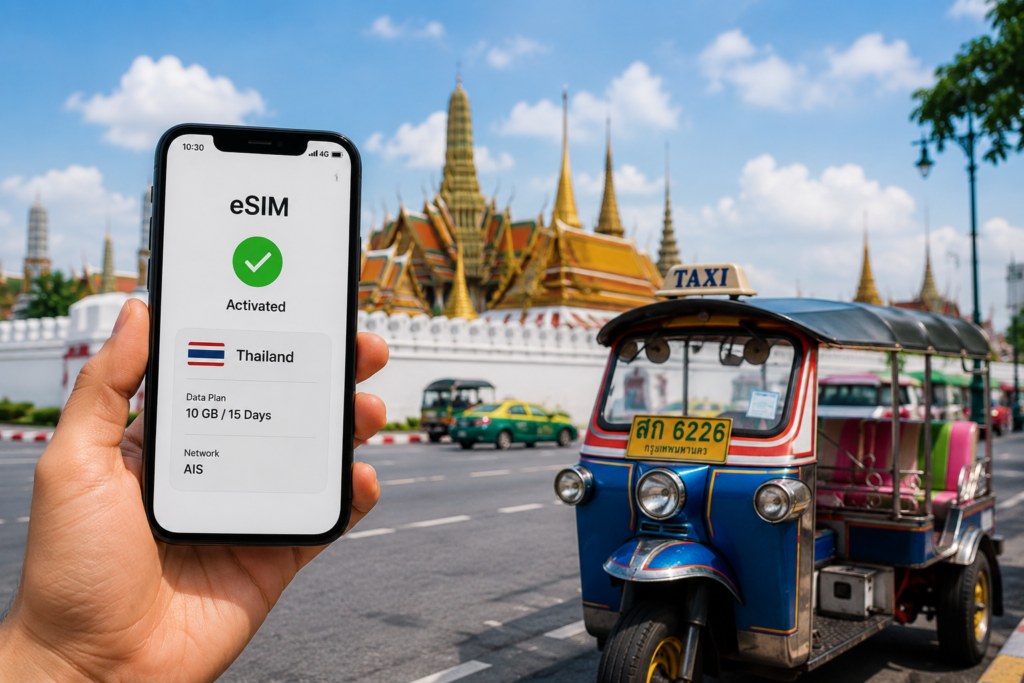
If you use a lot of mobile data and don’t want to think about gigabytes at all, Holafly is the easier unlimited-data option.
But Thailand is slightly different from destinations such as Italy or Portugal because the mobile network behind your eSIM actually matters—especially if you’re travelling beyond Bangkok.
Quick answer
Best eSIM for most Thailand trips: Airalo
Airalo is the option I’d buy for a normal Thailand holiday. Plans start at roughly $7 for 5GB/7 days, and there are both fixed-data and unlimited options.
More importantly, you can find Thailand plans using AIS or True/DTAC, giving you more control over the network you use. 👉Check Airalo Thailand plans and current prices.
Best for unlimited data: Holafly
Holafly is the simpler choice if you want unlimited mobile data throughout your trip and don’t mind paying more for it.
A 7-day Thailand plan is around $27.50, while 15 days costs around $50.50. 👉 Check Holafly unlimited Thailand plans.
Thailand eSIM options at a glance
| Airalo | Holafly | |
|---|---|---|
| Best for | Most travelers | Heavy data users |
| Starting price | Around $7 | $11.90 / 3 days |
| 7 days | 5GB from around $7 | Unlimited $27.50 |
| 10 days | Options including 3GB/day | Unlimited $36.50 |
| 15 days | Multiple options | Unlimited $50.50 |
| 30 days | Up to unlimited | Unlimited $73.90 |
| Networks | AIS and True/DTAC options | True/DTAC |
| Unlimited option | Yes | Yes |
| Hotspot | Full purchased allowance | Limited on unlimited plans* |
| Calls/SMS | Depends on plan | No — data only |
| Best feature | Network + plan choice | Unlimited simplicity |
*Holafly’s tethering allowance can vary by destination and plan. Check the current Thailand plan details before purchasing rather than assuming the limit used in another country applies to Thailand.
Why I would choose Airalo for Thailand
Airalo makes particularly good sense in Thailand because you aren’t limited to one type of plan.
At the cheaper end, you can get around 5GB for seven days for approximately $7.
At the other end, Airalo also offers unlimited Thailand options, including a 30-day unlimited plan around $34.95 on the DTAC network.
That means Airalo isn’t simply the “cheap limited-data option.”
You can choose based on how you’re actually travelling.
Airalo makes sense if you use your phone for:
- Google Maps
- Grab
- LINE
- Google Translate
- restaurant searches
- hotel bookings
- occasional video
That’s how most tourists use their phones.
If I’m spending two weeks travelling through Bangkok, Chiang Mai and the islands, I don’t automatically need unlimited data every day.
The big Thailand advantage: network choice
This is what makes Thailand different from many other Airalo destinations.
Depending on the plan, you can choose connectivity using AIS or True/DTAC.
That matters if your itinerary includes more than Bangkok.
I’ll explain the difference below, but neither is a bad choice for a normal tourist itinerary.
Hotspot use
Airalo also lets you share your purchased data allowance.
If you buy 10GB and want to tether your laptop, the hotspot simply consumes data from those 10GB.
There isn’t a separate tiny hotspot allowance eating into your ability to work.
That’s particularly useful if you’re travelling with a laptop. 👉 See current Airalo Thailand eSIM options.
When Holafly makes more sense
Holafly approaches Thailand differently.
Instead of deciding whether you need 5GB, 10GB or 20GB, you choose how many days you’re travelling and get unlimited mobile data.
Current example prices include:
| Duration | Price |
|---|---|
| 3 days | $11.90 |
| 5 days | $20.50 |
| 7 days | $27.50 |
| 10 days | $36.50 |
| 15 days | $50.50 |
| 30 days | $73.90 |
That costs considerably more than Airalo’s cheapest plans.
But that’s not really the point of Holafly.
You’re paying to stop thinking about data.
I’d choose Holafly if I were:
- streaming video regularly
- uploading lots of photos and video
- making frequent video calls
- using social media heavily
- staying online throughout the day
- unwilling to monitor remaining data
For a heavy user, the additional cost can make sense.
Holafly Thailand is data-only
One important clarification: you don’t get a Thai phone number for normal calls or SMS.
That’s unlikely to cause problems for most tourists.
You can still use:
- LINE
- FaceTime
- Messenger
- Telegram
And apps such as Grab work using mobile data.
What about hotspot use?
Holafly allows tethering on many plans, but unlimited-plan hotspot allowances can differ by destination.
I therefore wouldn’t publish a hard Thailand-specific daily number unless Holafly displays it on the exact plan you’re buying.
If laptop tethering is important to you, verify the current Thailand allowance before checkout.
For unrestricted sharing of a fixed data allowance, Airalo is the simpler option.
👉See current Holafly Thailand prices.
AIS vs True/DTAC: which network should you choose?
This is probably more useful to a Thailand traveler than another generic Airalo-vs-Holafly comparison.
Thailand has excellent mobile infrastructure, and both major network groups cover the places most visitors actually go.
AIS
AIS has traditionally had an excellent reputation for nationwide coverage.
I’d lean toward AIS if your itinerary includes a lot of:
- northern Thailand
- smaller towns
- road travel
- less-touristy areas
For a trip combining Bangkok and Chiang Mai, AIS is an easy choice.
If you’re heading north after Bangkok, our guide explains how to get from Bangkok to Chiang Mai.
True/DTAC
True and DTAC have combined their network operations, creating another huge nationwide network.
Coverage is excellent in:
- Bangkok
- Chiang Mai
- Phuket
- Krabi
- Pattaya
- major islands
- tourist resorts
For a standard Bangkok + beach itinerary, I’d have no concern using True/DTAC.
Which would I pick?
AIS if I had a network choice and planned to travel extensively around the country.
True/DTAC if the plan itself offered better pricing or unlimited data.
I wouldn’t pay substantially more simply to switch between them for a normal tourist itinerary.

Does eSIM work well in Bangkok?
Yes.
Bangkok has excellent 4G and 5G coverage, so network availability shouldn’t determine where you stay.
The bigger issue in Bangkok is transport.
If you haven’t booked accommodation yet, read our guide to the best areas to stay in Bangkok.
My main recommendation there is simple: stay within walking distance of BTS or MRT.
Your eSIM will also be useful immediately after landing for Google Maps, Grab and hotel directions.
What about Phuket, Krabi and the Thai islands?
Mobile coverage is generally very good in Thailand’s major beach destinations.
Expect strong service in:
- Phuket
- Krabi
- Koh Samui
- Pattaya
- major resort areas
Signal can naturally become weaker on remote beaches, boat trips or smaller islands.
That’s a geographic limitation rather than an Airalo or Holafly problem.
If you’re deciding where to spend the beach portion of your trip, see our Phuket vs Krabi guide for first-time visitors.
How much data do you actually need in Thailand?
Don’t buy unlimited data automatically.
For most travelers, Thailand doesn’t require as much mobile data as you might expect.
| Trip | Data I’d buy |
|---|---|
| 5–7 days | 5GB |
| 10 days | 5–10GB |
| 2 weeks | 10–20GB |
| Heavy social/video use | 20GB+ |
| Remote work | Unlimited |
A normal day might involve:
Google Maps + Grab + WhatsApp + restaurant searches + Instagram.
That isn’t going to consume several gigabytes unless you’re also watching video or constantly uploading high-resolution content.
What would I buy for two weeks?
For a two-week Bangkok + Chiang Mai + islands trip, I’d personally choose approximately 10–20GB.
That’s enough freedom to use my phone normally without paying for unlimited data I’m unlikely to consume.
If I were working remotely during those two weeks, I’d switch to unlimited.
Install your Thailand eSIM before departure
Do this at home.
Don’t wait until you’re standing inside Suvarnabhumi Airport trying to connect to public Wi-Fi.
The basic process is:
- Buy your eSIM.
- Install it using the provider app or QR code.
- Label it Thailand.
- Keep your normal SIM enabled if you still need incoming messages.
- Leave the Thailand eSIM turned off until arrival if instructed by your plan.
- After landing, select the Thailand eSIM for mobile data.
- Enable data roaming on the eSIM if required.
- Disable mobile data roaming on your home SIM.
Your phone should connect to the Thai network automatically.
Do not delete the eSIM after installation. Some eSIM profiles cannot simply be reinstalled from the same QR code.
Can you keep your normal WhatsApp number?
Yes.
Installing a travel eSIM doesn’t require changing your WhatsApp number.
Keep WhatsApp registered to your existing number and use the Thailand eSIM for mobile data.
Your contacts can continue messaging and calling you exactly as before.
Airalo or Holafly?
This article is about choosing an eSIM specifically for Thailand, so I’m deliberately not turning it into another provider comparison.
If you want a detailed breakdown of pricing philosophy, international coverage, support, hotspot policies and which provider wins overall, read:
Airalo vs Holafly: Which eSIM Should You Actually Buy?
That keeps the decision separate from the Thailand-specific coverage question.
Frequently asked questions
What’s the best eSIM for Thailand?
Airalo is my pick for most travelers. It combines relatively inexpensive plans with AIS and True/DTAC network options, flexible data allowances and straightforward hotspot sharing.
Choose Holafly when unlimited data matters more than price.
AIS or True/DTAC: which should I choose?
Both are excellent for mainstream tourist destinations.
I’d lean toward AIS for extensive travel around Thailand, particularly when visiting smaller towns or travelling overland.
For Bangkok, Chiang Mai, Phuket and other major destinations, either is a perfectly reasonable choice.
Is Holafly unlimited data actually unlimited in Thailand?
Holafly sells its Thailand plans as unlimited mobile-data plans. Remember that unlimited phone data doesn’t necessarily mean unlimited hotspot/tethering, so check the current tethering allowance if you intend to connect a laptop.
Can I hotspot my laptop?
Yes.
Airalo lets you share data from your purchased allowance.
Holafly’s hotspot rules on unlimited plans can be more restrictive, so verify the Thailand-specific allowance before buying if tethering is important.
How much data do I need for two weeks in Thailand?
I’d buy 10–20GB for a normal two-week holiday.
If you mainly use Maps, Grab, WhatsApp and occasional social media, 10GB may be enough.
If you stream or upload video regularly, consider 20GB or unlimited.
Do I need calls and SMS?
Probably not.
A data-only eSIM is enough for most tourists because WhatsApp, LINE, FaceTime and Messenger all work over mobile data.
Final verdict
For most people searching for the best eSIM for Thailand, I’d buy Airalo.
The combination of competitive prices, different plan sizes, AIS/True network options and unrestricted use of your purchased data for hotspot sharing makes it the strongest all-round option for a normal Thailand holiday. 👉 Check Airalo Thailand plans.
If you’re a heavy data user and don’t want to monitor usage, pay more and get Holafly’s unlimited plan. 👉 Check Holafly Thailand unlimited plans