Ayutthaya Historical Park protects the ruins of Ayutthaya, the capital of Siam from around 1350 until it was destroyed by a Burmese army in 1767. It lies about 80 km north of Bangkok and is a UNESCO World Heritage Site, inscribed in 1991. The ruins are spread across an island formed by three rivers and the surrounding area, so the best way to see them is by bicycle or tuk-tuk. Each major temple charges foreigners a separate fee, generally 50–80 baht, and most are open from 8:00 to 18:00. It is the easiest day trip from Bangkok, by train, minivan or boat tour.
Ayutthaya at a glance
| Location | Phra Nakhon Si Ayutthaya, about 80 km north of Bangkok |
| UNESCO status | “Historic City of Ayutthaya”, inscribed 1991 |
| History | Founded around 1350; capital of Siam for over 400 years; destroyed in 1767 |
| Entrance fees (foreigners) | Generally 50–80 THB per temple; some sites free |
| Opening hours | Main temples about 08:00–18:00 |
| Getting there | Train from Bangkok in about 1–2 hours; minivan about 1.5 hours |
| Time needed | One full day; two days to see the outlying temples without rushing |
A short history of Ayutthaya
Ayutthaya was founded around 1350 by King U Thong (Ramathibodi I) and became one of the largest and richest cities in Asia, trading with China, Japan, Persia and European powers such as Portugal, the Netherlands and France. At its height it had hundreds of temples and a population often estimated at about a million. In 1767 a Burmese army captured and burned the city, and the capital moved south, first to Thonburi and then to Bangkok. The ruins were restored by the Fine Arts Department from the late 1960s and declared a historical park in 1976. Ayutthaya came after Sukhothai, the first Thai capital, whose ruins are further north.
Ayutthaya entrance fees
There is no single ticket for the whole park. Each major temple has its own gate and fee:
- Major temples (Wat Mahathat, Wat Phra Si Sanphet, Wat Ratchaburana, Wat Chaiwatthanaram, Wat Phra Ram and others): generally 50 THB each for foreigners; some recent guides report 80 THB.
- Combined ticket: some guides mention a multi-temple ticket (quoted at 220 THB for six temples, and more recently around 300 THB). Ask at the first temple whether it is sold and which sites it covers.
- Free or donation-only: some smaller temples and the reclining Buddha at Wat Lokayasutharam.
- Active temples outside the island, such as Wat Yai Chai Mongkhon, may charge a small separate fee.
Cash only at most gates. Our Thailand currency guide explains how to get baht without high ATM fees.
Best temples in Ayutthaya
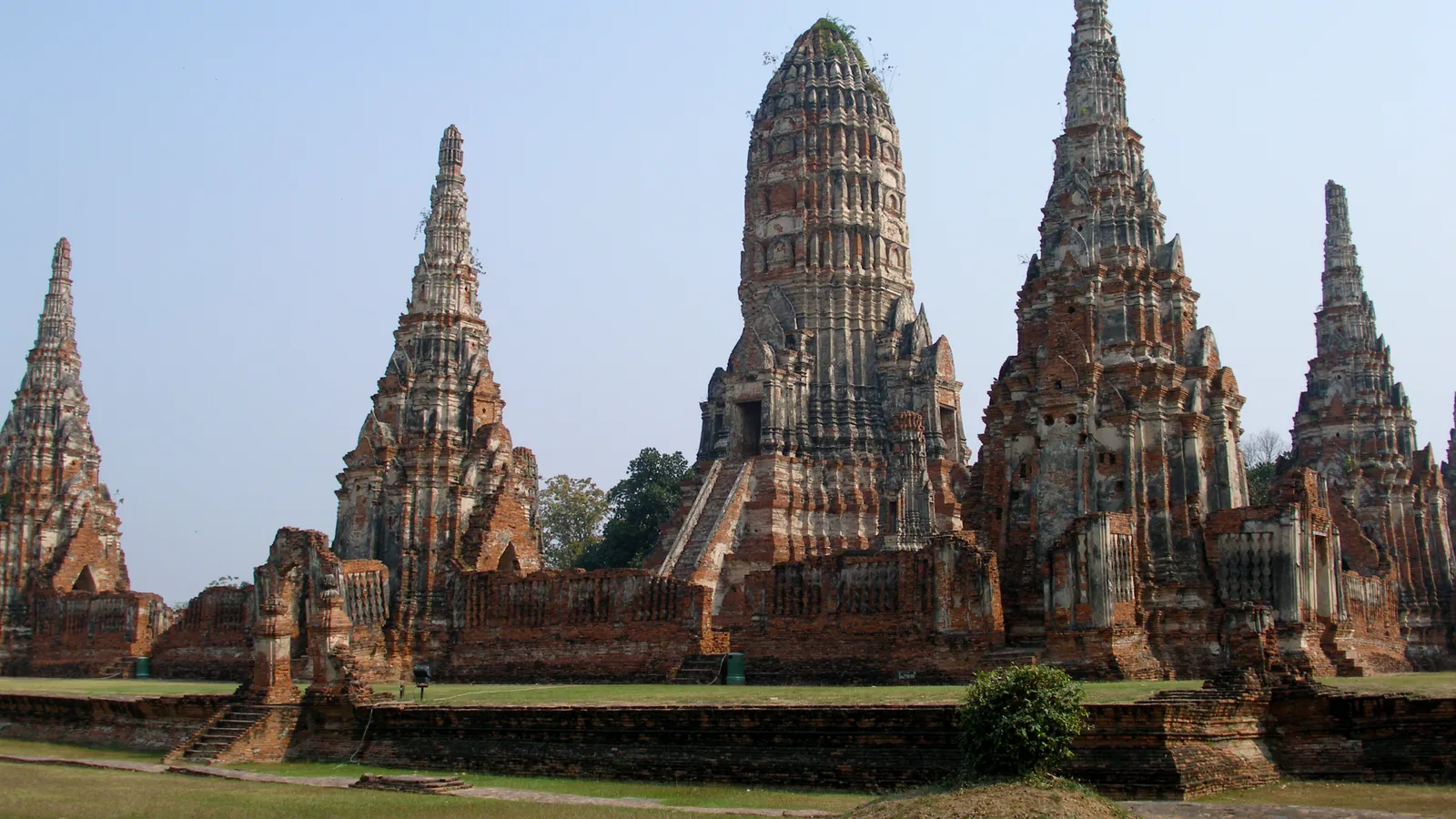
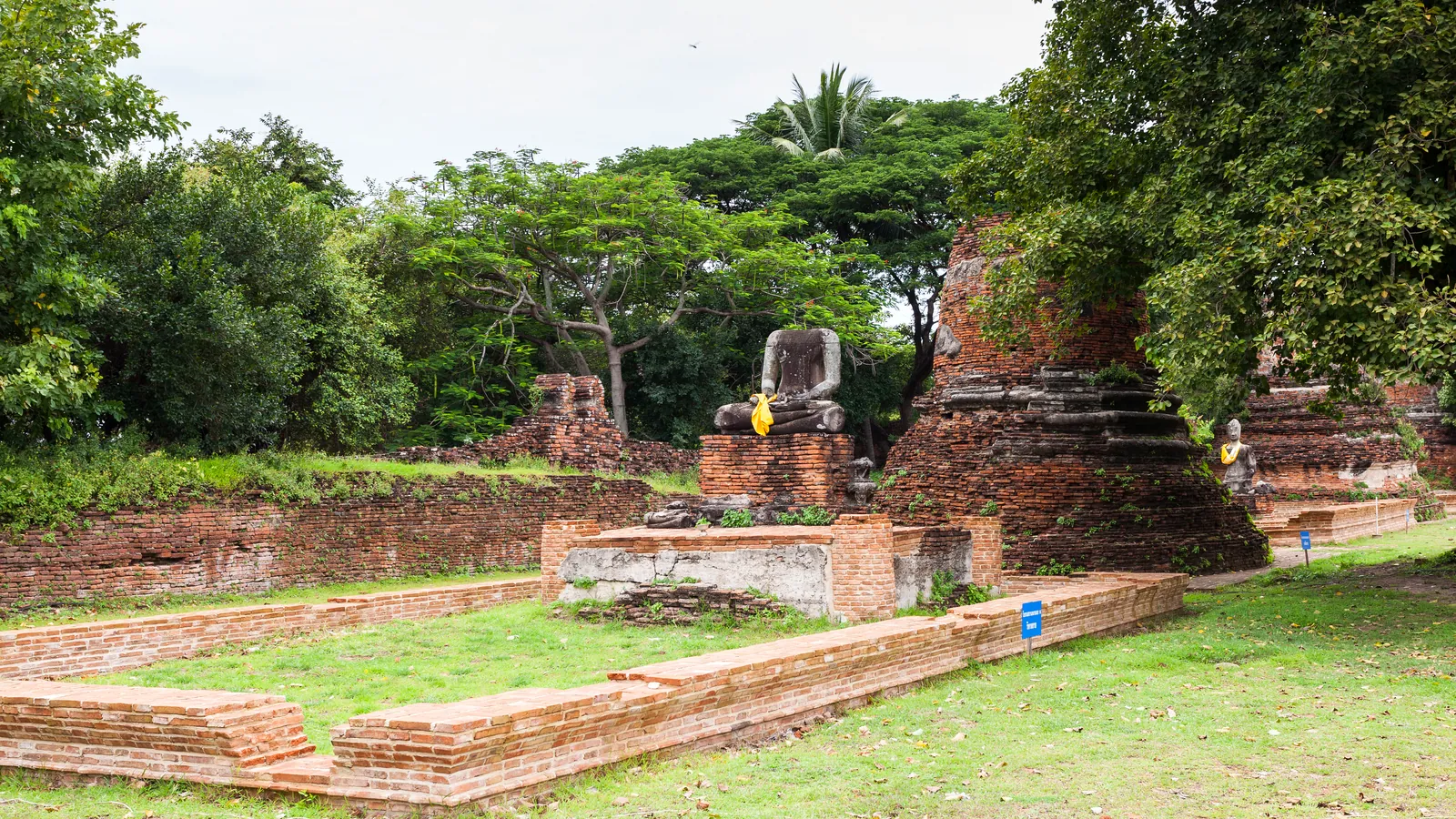
- Wat Mahathat: the famous Buddha head entwined in the roots of a tree, plus rows of headless Buddha images and a collapsed central prang.
- Wat Phra Si Sanphet: three bell-shaped chedis in a row, once the royal temple inside the palace grounds; the most photographed sight in Ayutthaya.
- Wat Ratchaburana: a tall, well-preserved prang you can climb partway, with a crypt that held gold treasures.
- Wat Chaiwatthanaram: a Khmer-style temple on the riverbank west of the island, best at sunset.
- Wat Lokayasutharam: a reclining Buddha about 42 metres long, in the open air.
- Wat Yai Chai Mongkhon: an active monastery south-east of the island, with a large chedi and rows of saffron-robed Buddha images.
- Wat Phanan Choeng: an active temple with a huge seated Buddha, popular with Thai and Chinese worshippers.
The Buddha head in the tree at Wat Mahathat
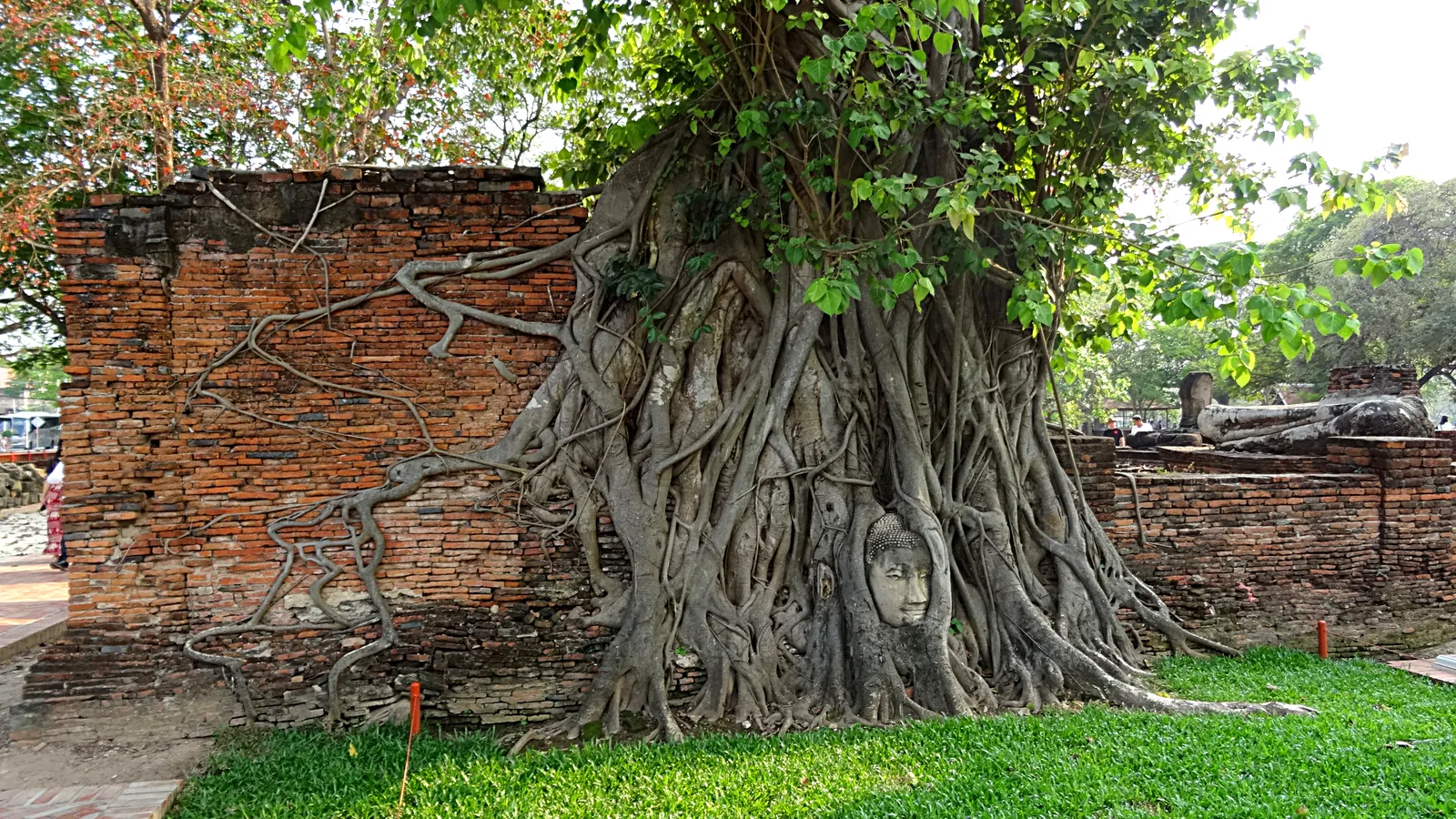
The sandstone Buddha head held in the roots of a fig tree is Ayutthaya’s most famous image. Photography is allowed, but your head should not be higher than the Buddha’s: crouch or kneel when you take a photo, and do not touch it or pose with it. A guard often watches and blows a whistle at people who get too close. Arrive at opening time to avoid the crowds.
How to get from Bangkok to Ayutthaya
- By train: the cheapest and most scenic option. Trains run frequently from Bangkok’s stations to Ayutthaya, taking about 1–2 hours depending on the train. Third-class seats cost only a few dozen baht; express trains cost more. Long-distance trains now leave from Krung Thep Aphiwat Central Terminal, while some ordinary trains still use Hua Lamphong, so check the State Railway of Thailand timetable for your train. From Ayutthaya station, a short ferry crosses the river to the island.
- By minivan: minivans from Bangkok’s Mo Chit area take about 1.5–2 hours and cost roughly 60–150 THB.
- By taxi or private car: about 1.5 hours; expect from about 1,500 THB one way for a private car.
- By boat tour: some tours go one way by road and return on the Chao Phraya River.
Getting around Ayutthaya
The temples are too spread out to walk comfortably in the heat. Bicycles can be rented near the train station ferry pier and on the island for about 50–80 THB a day; the island is flat but the traffic is busy, so stick to quieter roads. Tuk-tuks can be hired for a few hours or a half-day circuit, typically from around 200–400 THB an hour; agree the route and price before you go. Scooters are also available if you have a valid licence.
How long do you need in Ayutthaya?
A full day is enough to see the main temples on and around the island. Staying overnight lets you see Wat Chaiwatthanaram at sunset and the ruins in the quiet early morning, before the day-trippers arrive, and visit the outlying temples at a relaxed pace. Ayutthaya also fits on the way north from Bangkok to Chiang Mai or Sukhothai.
Dress code and etiquette
Cover your shoulders and knees, especially in active temples such as Wat Yai Chai Mongkhon and Wat Phanan Choeng, and take off your shoes where required. Do not climb on ruins or Buddha images, and do not sit with your feet pointing towards a Buddha. Bring water, a hat and sunscreen: there is little shade between the temples.
Best time to visit Ayutthaya
November to February is the most comfortable time, with cooler, drier weather. March to May is very hot, so start early. The rainy season runs from about June to October; the area around Ayutthaya is prone to flooding late in the season, as in the severe floods of 2011, so check conditions if you visit in September or October. See the best time to visit Thailand for more.
Ayutthaya vs Sukhothai
Ayutthaya is the easy day trip from Bangkok, with more famous sights but bigger crowds and ruins scattered through a modern town. Sukhothai Historical Park is older, greener and much quieter, but it is 6–9 hours from Bangkok by bus. If you have only a day from Bangkok, choose Ayutthaya; if you are travelling north towards Chiang Mai with time to spare, see both.
Planning the rest of your trip? See our Thailand itinerary, how much a trip to Thailand costs and whether Thailand is safe.
Compare hotels in Ayutthaya on Booking.com
FAQ
Is Ayutthaya worth visiting?
Yes. It is the most accessible ancient city in Thailand and an easy, cheap day trip from Bangkok, with some of the country’s most iconic temple ruins.
Can you do Ayutthaya as a day trip from Bangkok?
Yes. Take an early train, rent a bicycle or hire a tuk-tuk on arrival, and return in the evening. Staying overnight is worth it if you want sunset and early-morning visits.
Why are so many Buddha statues in Ayutthaya headless?
Many were damaged when the Burmese army sacked the city in 1767, and many more heads were later removed by looters and sold on the antiques market.