The currency of Laos is the Lao kip (LAK, symbol ₭), and it is what you pay with almost everywhere: guesthouses, restaurants, tuk-tuks, markets and bus tickets. In November 2026, $1 buys about 22,700 kip, so the biggest note, 100,000 kip, is worth roughly $4.40. US dollars are mainly for the visa on arrival and some tours, Thai baht works near the Thai border, and most foreign-card ATM withdrawals are capped at 2,000,000 kip (about $88) with a 30,000–40,000 kip fee each time.
Quick answer
| Official currency | Lao kip (LAK), symbol ₭ |
| Exchange rate (Nov 2026) | About 22,700 kip = $1 |
| Banknotes | 500, 1,000, 2,000, 5,000, 10,000, 20,000, 50,000 and 100,000 kip; no coins in use |
| US dollars | Visa on arrival, some tours and travel agencies; rarely for daily spending |
| Thai baht | Accepted in border towns and often for motorbike and car rental |
| ATM limit for foreign cards | Usually 1,000,000–3,000,000 kip per withdrawal, depending on the bank |
| ATM fee | About 20,000–40,000 kip per withdrawal at the local bank, plus your own bank’s fee |
| Cards | Mainly better hotels and some shops, usually with a 2–3% surcharge |
| Leftover kip | Hard to exchange outside Laos; spend it or change it before you leave |
What is the currency of Laos?
Laos uses the kip, issued by the Bank of the Lao PDR. The currency code is LAK and the symbol is ₭, though in shops you will mostly see prices written as plain numbers, often shortened with a “k” (for example 25k for 25,000 kip). The word kip comes from the Lao word for an ingot. The kip was once divided into 100 att, but att are no longer used, and there are no coins in everyday circulation.
The kip is a closed currency, which means it is not traded freely outside the country. That has two practical effects for travelers: you cannot easily buy kip before you arrive, and you will struggle to sell it back once you leave.
How much is $1 in Lao kip?
On 10 November 2026, $1 was worth about 22,700 kip on the mid-market rate. Exchange counters and banks pay a little less. The kip has lost a lot of value since 2019, so rates in older guides (8,000 or 10,000 kip to the dollar) are badly out of date. Check the day’s rate before you change money, for example on the BCEL exchange-rate page.
| Kip | Approx. US dollars | What it typically buys |
|---|---|---|
| 10,000 kip | $0.45 | Bottle of water, short market purchase |
| 20,000 kip | $0.90 | Baguette sandwich or a fruit shake |
| 50,000 kip | $2.20 | Noodle soup or a street-food meal |
| 100,000 kip | $4.40 | Meal at a local restaurant |
| 1,000,000 kip | $44 | Roughly two days on a backpacker budget |
| 2,000,000 kip | $88 | One typical ATM withdrawal |
A simple way to convert in your head: drop the last three zeros and divide by 22. So 66,000 kip is about 66 ÷ 22 = $3.
How much is $1000 USD in Laos?
At about 22,700 kip per dollar, $1,000 is roughly 22.7 million kip. In practice you will get a bit less after exchange spreads or ATM fees. With the biggest note worth around $4.40, $1,000 in cash is a stack of about 227 notes of 100,000 kip, which is one reason most travelers withdraw in smaller amounts as they go rather than changing everything at once.
Lao kip banknotes
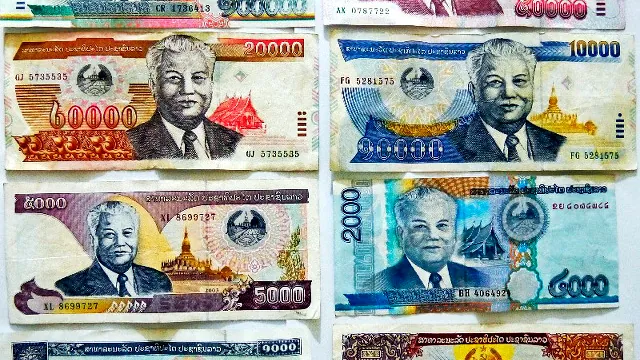
The notes in circulation are 500, 1,000, 2,000, 5,000, 10,000, 20,000, 50,000 and 100,000 kip. Most carry a portrait of Kaysone Phomvihane, the founding leader of the Lao PDR, so check the number and colour rather than the face. The 500 and 1,000 kip notes are almost worthless and you will rarely see them in tourist areas.
ATMs mostly give out 100,000 kip notes, and small vendors often cannot change them. Break big notes at supermarkets, convenience stores, cafés or your guesthouse, and keep a supply of 10,000 to 50,000 kip notes for tuk-tuks, markets and street food. Torn, heavily creased or damaged notes are often refused, both kip and foreign cash, so check your change.
Kip or dollars: what should you bring to Laos?
Plan to spend kip. Unlike in Cambodia, where the US dollar dominates, prices in Laos for food, rooms and local transport are set in kip, and paying in dollars usually means a poor rate rounded in the seller’s favour.
US dollars still have a job. The visa on arrival is paid in US dollars (bring clean notes; old or damaged bills can be refused), and some tour operators, travel agencies and adventure activities quote prices in dollars. A small reserve of $100–200 in clean $20 notes is also a good backup in case your cards stop working, since dollars are the easiest foreign currency to exchange.
Can you use Thai baht in Laos?
Sometimes. Thai baht is accepted in towns close to the Thai border, such as Vientiane and Huay Xai, at land crossings, and often for motorbike or car rental. Away from the border it is less useful, and the rate a shop gives you will be worse than if you paid in kip. If you are arriving overland from Thailand, a few hundred baht is handy for the first hours, but switch to kip as soon as you can. For the Thai side of the trip, see our guide to ATM fees in Thailand.
Vietnamese dong and Chinese yuan can be exchanged in larger towns and near those borders, but are not used for everyday payments.
ATMs in Laos: fees, limits and which banks to use
ATMs are easy to find in Vientiane, Luang Prabang, Vang Vieng, Pakse and other towns, but scarce in rural areas and on the 4,000 Islands, so withdraw before heading somewhere remote. Every Lao bank charges foreign cards its own fee per withdrawal, and limits are low, so you may need several withdrawals over a trip. Figures below are from traveler reports and guides updated in 2025–2026; banks change them often.
| Bank | Max per withdrawal | Typical fee | Notes |
|---|---|---|---|
| BCEL | 2,000,000 kip | 30,000 kip (about $1.30) | Most widespread network; some branches allow larger counter withdrawals |
| JDB | 2,000,000 kip | Around 3% (reports vary) | Common in towns |
| Indochina Bank | 3,000,000 kip | 40,000 kip | Visa cards only |
| LDB | 1,500,000 kip | About 20,000 kip per million; some cards report no fee | Results depend on your card |
| Phongsavanh Bank | 1,000,000 kip | About 20,000 kip per million | Low limit means more fees |
| ANZ | 2,000,000 kip | About 20,000 kip per million | Mainly Vientiane |
Your home bank may add its own foreign ATM fee and a conversion margin on top. A card with low conversion costs, such as the Wise card, cuts that second layer, though it cannot avoid the local bank’s fee.
- Always take the maximum the machine allows, because the fee is charged per withdrawal.
- Choose to be charged in kip if the ATM offers to convert into your home currency. That conversion (dynamic currency conversion) usually costs several percent more.
- Bring both Visa and Mastercard. Visa works at almost every ATM; some machines, including Indochina Bank’s, reject Mastercard.
- Use ATMs attached to bank branches during opening hours, so you can get your card back if the machine keeps it.
Where to exchange money in Laos
Licensed exchange counters in town centres and banks usually give the best rates for cash. Banks will ask for your passport. Airport counters and hotels tend to pay less, and tour agencies and market moneychangers are usually the worst option. US dollars, euros and Thai baht are the easiest currencies to change; other major currencies such as the pound, Australian dollar or yuan are accepted at bigger exchange offices in Vientiane and Luang Prabang.
Because the kip is a closed currency, you will not find it at most exchange offices abroad. Change only what you need for the next few days, and spend or exchange leftover kip before you fly out. Some banks and exchange booths on the Thai side of the border will take kip, but at a poor rate.
Cards and QR payments in Laos
Card payments are limited to better hotels, some restaurants and shops in the main towns, and often come with a 2–3% surcharge. American Express is almost never accepted. Plan on cash for guesthouses, buses, street food and markets.
Lao QR codes are now common at shops and cafés in Vientiane and Luang Prabang, much less so in rural areas. Foreigners can pay them with EzyKip, a wallet backed by BCEL that you top up with a foreign card for a fee of about 2–3%. It is handy if you want to carry less cash, but it does not replace cash in Laos yet.
How far does a dollar go in Laos?
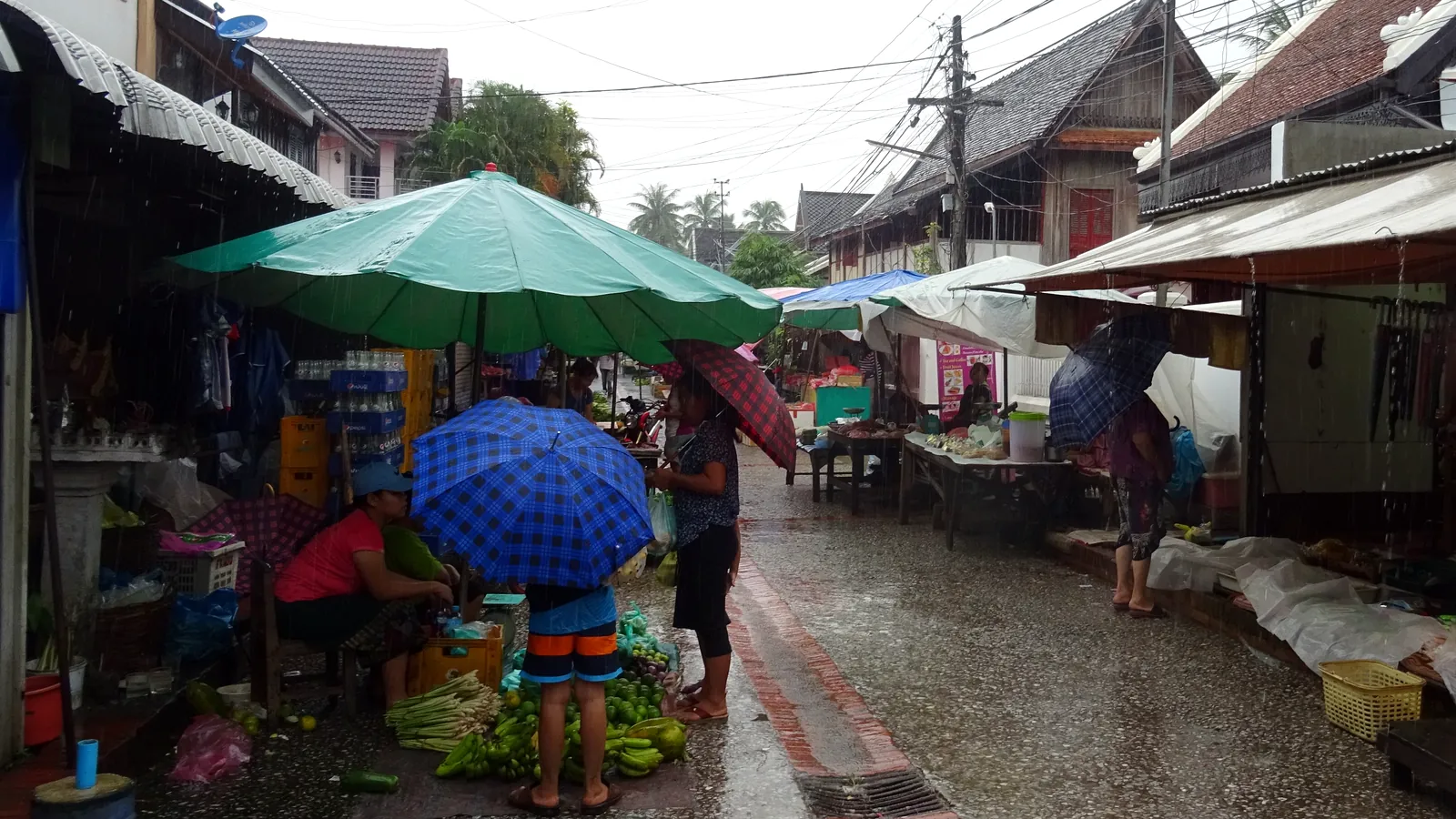
Quite far. A street-food meal costs about $2–3, a meal in a local restaurant $3–5, a hostel bed $6–12 and a guesthouse room $12–22 a night. Most travelers spend $30–60 a day excluding international flights; backpackers can manage on $25–35. Our full Laos trip cost breakdown has prices for transport, activities and sample itineraries.
Is Laos cheap or expensive?
Laos is one of the cheapest countries in Southeast Asia for travelers, mostly because the kip has weakened so much against the dollar and euro since 2019. Local prices have risen in kip, but for visitors paying with foreign money, food, rooms and transport remain cheap. The exceptions are imported goods, Western food and organised tours, which cost much the same as in neighbouring countries.
Is Thailand or Laos cheaper?
Laos is usually cheaper for day-to-day costs. Guesthouses, local meals and buses typically cost less than in Thailand, especially outside Bangkok’s and the islands’ tourist zones. Getting around Laos can take longer and cost more per kilometre on some routes, and flights into Laos are often pricier, so the overall trip difference is smaller than daily prices suggest. Travelers on a $30–60 daily budget in Laos would need a little more for the same comfort in most of Thailand.
How much cash do you need per day in Laos?
Because most things are paid in cash, plan to carry roughly what you spend in a day or two: about 700,000–1,400,000 kip ($30–60) per person per day on a typical budget. One full ATM withdrawal of 2,000,000 kip covers about two to three days for a budget traveler. Before travelling to small villages, the 4,000 Islands or long trekking trips, take enough kip for the whole stay, because ATMs may be missing or empty.
Tipping in Laos
Tipping is not a traditional part of Lao culture and is not expected in local eateries or for tuk-tuk rides. It is appreciated, though. Rounding up the bill or leaving 10,000–20,000 kip at a sit-down restaurant is generous, and guides and drivers on day tours or multi-day treks are commonly tipped. Some upscale restaurants and hotels add a service charge, in which case nothing extra is needed.
What currency did Laos use before 1975?
Before 1975 Laos was a kingdom, and it used the royal kip, introduced in the early 1950s (1953 in most records) to replace the French Indochinese piastre. After the communist Lao People’s Democratic Republic took power in 1975, the royal kip was replaced in 1976 by the “liberation” kip at 20 royal kip to 1, and on 16 December 1979 that was replaced by the current kip at 100 old kip to 1 new kip. Old royal notes now only turn up as collector’s items, and they have no value in shops.
Money mistakes to avoid in Laos
- Miscounting zeros. 10,000 and 100,000 kip notes can look similar in low light; check before you hand them over.
- Exchanging too much. Leftover kip is hard to sell abroad, and the currency keeps losing value.
- Accepting conversion at the ATM or card terminal. Always pay in kip.
- Bringing damaged dollars. Torn or very old notes may be refused for the visa or at exchange counters.
- Relying on one card. Bring a backup card on a different network and some emergency cash.
- Leaving the main towns without cash. Rural areas and islands may have no working ATM.
Comparing currencies in the region? Read our guides to Vietnam’s currency and Cambodia’s currency, or browse all our Laos travel guides.
FAQ
Can I get Lao kip before I travel?
Rarely. Because the kip is a closed currency, few banks or exchange offices outside Laos stock it. It is simpler to arrive with US dollars, euros or baht and withdraw or exchange kip on arrival.
Are there ATMs at Laos airports?
Yes, the international airports in Vientiane and Luang Prabang have ATMs and exchange counters, but airport exchange rates are usually worse than in town. Withdraw or change only enough for transport into town if you want the best rate.
What is the largest kip note?
The 100,000 kip note, worth about $4.40 in November 2026.
Can I pay for the visa on arrival in kip?
The visa on arrival is normally paid in US dollars. Some land borders accept Thai baht or Vietnamese dong, but the amount works out higher, so bring clean US dollar notes.